Auchtertool Kirk Est. 1178. Welcome to the website of Auchtertool Parish Church

A guide to the history of Auchtertool Parish Kirk

Visitors are welcome to our regular Sunday service at 9.30 am
For a map of our location please visit Google Maps

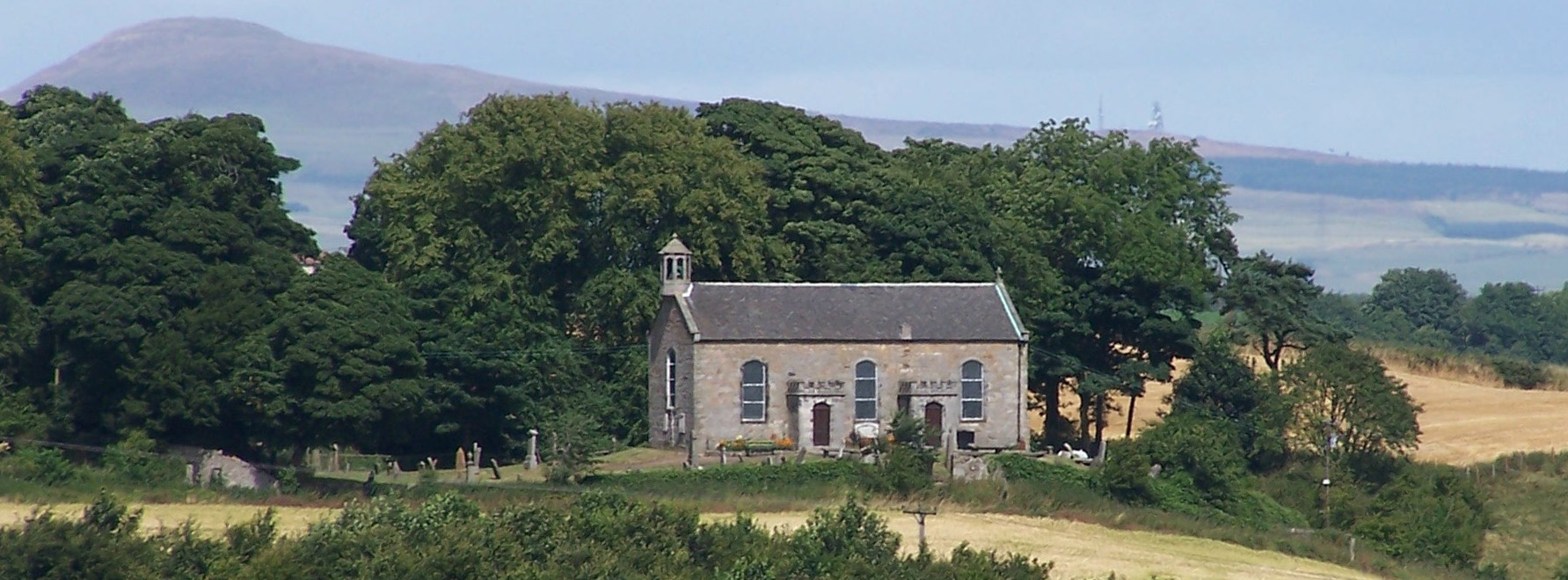
Stained glass window depicting Jesus Christ with haloWalk through the gates and climb the steps that lead up to the church. Look around at the surrounding countryside and notice how the Church has been built on a small hill. This gives a tremendously open view. Sometimes this spot is lashed by the wind and rain, but at other times it is bathed in glorious sunshine.

This perhaps provides a hint about how long people have worshipped on this site. Long before Christianity was established in Scotland, many people took part in “sun worship” and carried out their rituals on high ground such as this. These places of worship were sometimes taken over by the first Christian worshippers who built the early churches on the same ground.

The Roman Empire provides one of the best starting points for any historical study. The Romans’ most secure Scottish fortification was Antonine’s Wall linking the Forth and the Clyde. Occasionally the Romans did make sorties further north; it is recorded that Agricola’s forces entered Fife in 83 A.D. It is likely that the Battle of Orrea took place very close to the boundary of Auchtertool’s Parish, in the area of Ballingry. There is a hill to the East of Auchtertool Kirk, known as Castle Hill which was possibly the site of a Roman Camp.

Auchtertool Kirk in the historical perspective

Celtic Times

Segment of stained glass window showing angel with haloScotland’s early Christianity developed as part of our Celtic culture. There is a tradition that part of the Kirk’s east gable dates from this era, although naturally such claims are almost impossible to prove. Throughout the country there are very few memorials left to the Celtic Christians; their churches and monuments were much less lasting than those of the later Roman (Catholic) Church.

In Celtic times. Fife was divided into two districts, covering the east and the west. The area of Auchtertool’s Parish was within the Western district which was known as Fothrif or Fothrick.

(It was not until recent times that spellings were standardised for place names. In early times there were many different spellings of Auchtertool. The name Auchtertool developed from two Celtic words, Unchdar—meaning height and Tuil—meaning a slow flowing stream.)

Points of Interest: As you look to the South East from this viewpoint, it is possible to catch a glimpse of Balmuto Castle. High up on the East gable of the church there is a plaque containing the arms of one of the former lairds, William Forbes of Craigievar.

The Roman Church

The Abbots and Bishops of Dunkeld

Segment of stained glass window showing ‘suffer little children to come unto me’ bannerWhen the Roman (Catholic) Church was established in Scotland, the district of Fothrick came under the supervision of the Abbots of Dunkeld. Malcolm Canmore’s son Ethelred was made both Earl of Fife and Abbot of Dunkeld; thus he became absolute lord of the district and the royal house kept control of the church’s lands.

In 1127 the bishopric of Dunkeld was created. King David I gifted the lands of Auchtertool to the new bishop; from that point onwards the lands of the parish were the property of successive Bishops of Dunkeld.

The Priors and Abbots of Inchcolm

It is not known whether a church at Auchtertool was included in the gift to the Bishop of Dunkeld. However, it is recorded that in 1178 Pope Alexander III gifted the church of Ochtertule to Walter, Prier of lnchcolm.

The Priory of Inchcolm (which was raised in status to that of an Abbey in 1235) lies in the River Forth on the island of Inchcolm and was originally the home for a group of Augustinian Canons. From 1178 to the time of the Reformation, the Prior (later Abbot) of Inchcolm was responsible for presenting priests to minister at Auchtertool Church.

It is most likely that Canons from the Abbey fulfilled that role; they certainly ministered at the nearby church in Aberdour which was also the Abbey’s responsibility, The gifting of the church to Inchcolm provides us with the earliest recorded dating of a kirk at Auchtertool. Since then the actual church building has been substantially remodeled and altered both inside and out. However, stones from the ancient churches are almost certainly contained within its walls. At the turn of the century carved stones, possibly from Norman times, were discovered in the north wall. There were signs that the church has been altered and rebuilt up to five times.

Patron Saints of Auchtertool

The Roman Church followed the practice of entrusting its various members and parts to the protection and oversight of particular saints. The Church at Auchtertool was originally under the charge of St Columba; however in 1421 a Papal Bull transferred Auchtertool to the protection of St Peter.

The Reformed Church

The Break with Rome

Segment of stained glass window with small crossThe 16th Century was a time of upheaval for the Church in Scotland and the effects of the Reformation in Europe were beginning to be felt. In 1560 the Reformation Parliament met; amongst its members was James Stewart, the Abbot of Inchcolm. This signaled the end of lnchcolm’s status as a functioning Abbey and thus its role in parishes such as Auchtertool came to an end.

The exhibits at Auchtertool Kirk- date from after the time of the Reformation and the history of this period is very well catalogued. Although we do not know the names of any of Auchtertool’s serving Canons and Priests from Roman (Catholic) times, the names of all subsequent ministers are recorded. The oldest surviving monument in the churchyard dates to 1604.

A struggle—Bishops or Presbyteries?

Segment of stained glass window with angel pointing heavenwardAlthough the Scottish Kirk had now broken its ties with the Roman Church (and papal authority), an Episcopal system of bishops was still in place. Technically Auchtertool Church remained under the authority of the Bishop of Dunkeld, but in reality a great deal of influence lay with the local lairds. The Act of Supremacy in 1690 marked the end of a one hundred and thirty year struggle between supporters of Episcopacy and those who instead advocated Presbyterian church government.

It is recorded that the people of Auchtertool were in fact quite happy with prelacy (bishops). The sitting minister of Auchtertool Church was deposed for refusing to acknowledge the authority of the Presbytery of Kirkcaldy.

The advent of Presbyterianism put in place the system of church government which still operates in today’s national Kirk. In the Church of Scotland decisions are made collectively by courts instead of by individuals. Auchtertool Kirk has its own Kirk Session and is also represented on the Presbytery of Kirkcaldy and the General Assembly.

Top

Design by Coded Digital Design